
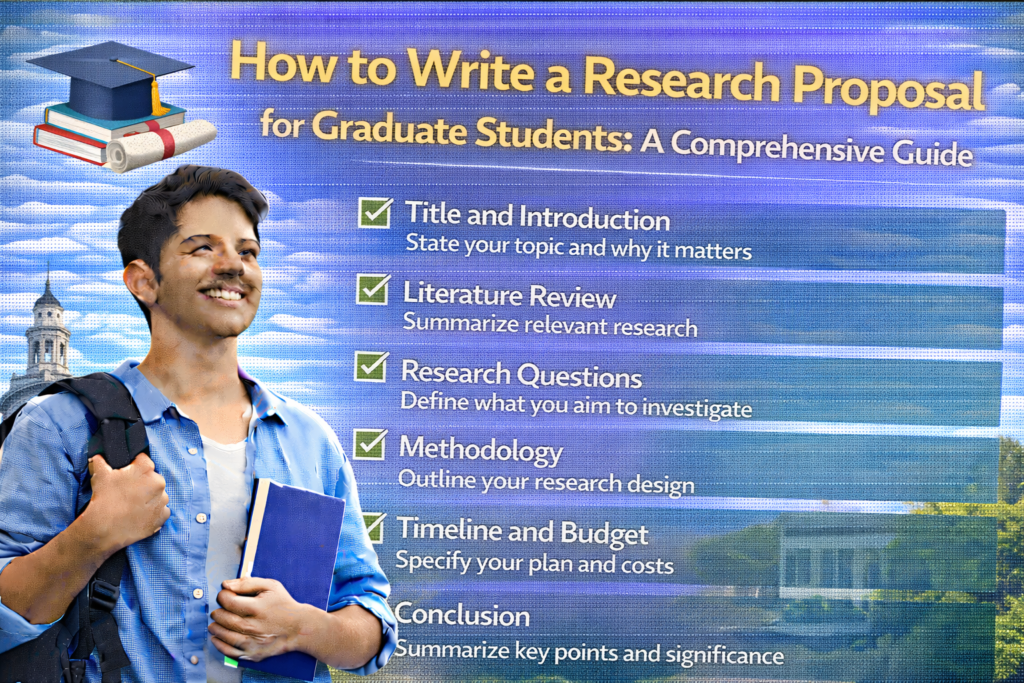
A research proposal is essentially your “blueprint” for innovation. For a graduate student—especially one like you, pursuing a B.Tech in Artificial Intelligence at SRM—this document is the difference between a simple academic project and a high-impact research opportunity. Whether you are applying for a Master’s degree in Japan or a research internship like the Mitacs Globalink, your proposal must prove that your idea is original, feasible, and scientifically sound.
Since you have a unique background in AI and Digital Marketing (from your time at upGrad and edbgo), you can leverage that “real-world data” perspective to make your proposal stand out. This guide organizes the essential steps into the informational, FAQ-style segments you prefer.
1. What are the Core Elements of a Research Proposal?
A well-structured proposal acts as a roadmap for your future supervisor. It must contain specific building blocks to be taken seriously by a committee.
- Title: Concise and descriptive. Example: “Optimizing Real-Time Consumer Engagement Using Generative AI Models.”
- Abstract: A 250-word “elevator pitch” of your entire project.
- Introduction: Provides the “Why.” What is the background of the problem, and why does it need solving now?
- Literature Review: Shows you’ve done your homework. What have other AI researchers said about this topic? Where is the “gap” that your project will fill?
- Research Questions/Hypotheses: These must be clear and testable.
- Methodology: The “How.” This is the most important section for an AI student. Will you use Neural Networks? What datasets will you use? How will you analyze the results?
- Expected Outcomes: What do you hope to find? Mention practical implications (e.g., “This could reduce digital marketing costs by 20%”).
- Significance: Why does this matter to the field of AI or to society?
2. Strategic Steps to Writing Your Proposal
To avoid feeling overwhelmed, break the writing process into these logical phases:
- Select a Feasible Topic: Don’t try to solve “General AI.” Instead, focus on something specific, like “Enhancing SEO Algorithms through Natural Language Processing.”
- Conduct the Literature Review: Use tools like Semantic Scholar or Research Rabbit to find the most recent (2024-2026) papers in your field.
- Develop the Methodology: As an SRM student, you have access to technical labs. Describe the hardware and software (e.g., Python, PyTorch) you plan to use.
- Draft the Sections: Write the methodology and intro first; save the abstract and title for the very end.
- Edit for “Human Tone”: Even though it’s technical, ensure it doesn’t sound like it was written by a bot. Use active voice (“I will implement…”) instead of passive voice (“It will be implemented…”).
3. Common Mistakes to Avoid in 2026
- Being Overambitious: A Master’s research project is usually 1-2 years. Don’t propose a 10-year project. Focus on one clear, achievable goal.
- Vague Methodology: Simply saying “I will use AI” is not enough. You must specify the architecture, the data source, and the validation metrics (e.g., F1-score, RMSE).
- Ignoring Ethics: Especially in AI, you must include a section on Data Privacy and Algorithmic Bias.
- Insufficient Literature Review: If you don’t cite recent papers, the committee will think your research is already outdated.
4. Pro-Tips for AI & Marketing Students
Since you have experience at upGrad and edbgo, use that to your advantage. A proposal that says, “I saw this specific problem in the digital marketing industry during my internship, and I want to build an AI model to solve it,” is incredibly persuasive. It shows that your research is grounded in real-world need rather than just theory.
- Mention Your Internships: Briefly reference your work at upGrad to justify the “Rationale” for your research.
- Format Matters: Follow the university’s specific guidelines (e.g., IEEE or APA format). Professionalism in formatting suggests professionalism in research.
Frequently Asked Questions (FAQ)
How long should a research proposal be? For most Master’s applications, 5 to 10 pages is standard. For a research internship, it might be shorter (2-3 pages).
Can I change my topic once I get admitted? Yes! A proposal is a “proof of concept.” Once you start working with a professor, the topic almost always evolves.
Should I include a budget? Only if the scholarship or grant specifically asks for it. For most graduate admissions, a budget is not required.
How do I find a research gap? Look at the “Future Work” or “Limitations” section of recent papers. These are essentially “to-do lists” left by other researchers.
Conclusion: Your Blueprint for Success
Writing a research proposal is a rewarding challenge that forces you to think like a scientist. By being clear, following a logical structure, and grounding your AI interests in practical experience, you will create a document that not only impresses professors but also secures your place in a top-tier graduate program. Good luck with your 2026 applications!
This video is a great companion to this guide, as it visualizes the drafting process for each section and provides a live example of an engineering-focused proposal.