
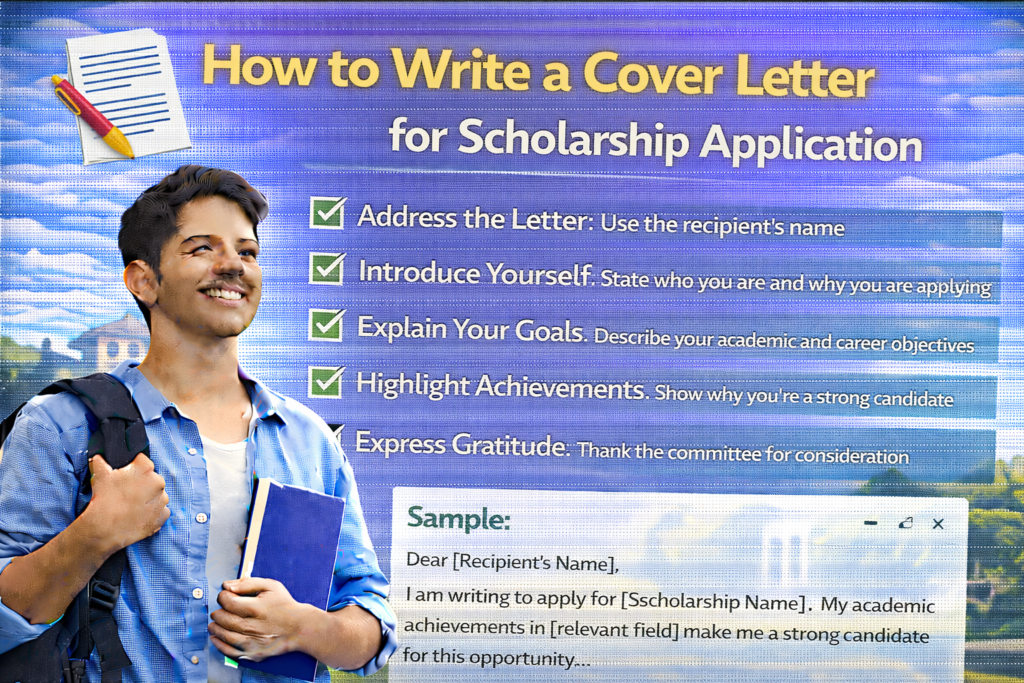
In the high-stakes world of global education, your scholarship cover letter is the “human element” that bridges the gap between your raw data and your true potential. For a final-year B.Tech student in Artificial Intelligence at SRM, your technical skills are impressive, but the committee wants to know the person behind the code. Why do you care about AI? How has your work at upGrad or edbgo shaped your view of the world?
This guide provides a structured, informational breakdown to help you craft a cover letter that feels authentic and professional, organized into the FAQ-style segments you find most helpful.
1. What is the True Purpose of a Scholarship Cover Letter?
A cover letter is far more than a simple introduction; it is your opportunity to present a 360-degree view of who you are. While your transcripts show your grades, the cover letter shows your character.
- Personality & Motivation: It allows the committee to see what drives you beyond just getting a degree.
- Aspiration: It details how you plan to use your education to make a tangible impact.
- Context: It provides a space to explain your financial situation or unique life challenges in a professional way.
2. Why is Researching the Scholarship Provider Non-Negotiable?
Before you write a single word, you must understand the mission of the organization offering the money. A scholarship from a tech giant like Google will look very different from a community-based leadership award.
- Alignment: Tailor your goals to match their vision. If they value “Innovation,” focus on your AI projects. If they value “Community,” focus on how your work helps small businesses.
- Specific Initiatives: Mentioning a specific project or value the provider supports shows you aren’t just sending out “copy-paste” applications.
3. How Do I Structure an Engaging Opening?
The first paragraph is your “hook.” Instead of starting with “I am writing to apply,” try to create an immediate connection.
- The Anecdote: Use a brief story. Perhaps mention a specific moment during your digital marketing internship where you saw the power of data.
- The Metaphor: Compare your journey to something relatable. “Just as an AI model requires high-quality data to learn, my academic journey has been fueled by a diverse range of experiences…”
- Direct Salutation: Always try to find a specific name. If the “Scholarship Committee” is the only option, ensure the rest of the tone is personalized.
4. Showcasing Achievements and Values
This is where you combine your technical “grit” with your personal “values.” Don’t just list achievements; connect them to your future.
- Academic Milestones: Mention your 9.0+ CGPA and your specialization in Artificial Intelligence at SRM.
- The Leadership Angle: Discuss your roles at upGrad or edbgo. How did you lead a project? How did you handle a technical failure?
- Rhetorical Engagement: Use questions to keep the reader thinking. “What if AI could bridge the digital divide for small-scale entrepreneurs?”
5. Discussing Financial Need with Transparency
Discussing money can be difficult, but it is necessary. The key is to be direct and positive.
- Be Clear: Articulate the specific hurdles, such as the high cost of international tuition or currency exchange challenges.
- The Investment Mindset: Frame the scholarship as an investment. “This financial assistance would allow me to shift my focus from part-time work to full-time research in [Your Topic].”
6. The 2026 Checklist for Impactful Writing
To ensure your letter stands out in a pile of thousands, follow these stylistic rules:
- Active Voice: Use strong verbs. “I developed” instead of “I was involved in the development of.”
- Brief & Focused: Every sentence must earn its place. Avoid “fluff” and repetition.
- Personal Pronouns: Use “I” and “my” to maintain a conversational, human touch.
- Human-Centric AI: Since you are an AI student, ensure your letter doesn’t sound like it was generated by a bot. Infuse it with your specific passion.
Sample Scholarship Cover Letter Template
[Your Name] [Phone Number] | [Email Address] [LinkedIn Profile Link]
[Date] [Scholarship Committee Name] [Organization Address]
Dear [Name of Recipient or Scholarship Committee],
I am writing to express my profound interest in the [Name of Scholarship]. As a final-year B.Tech student in Artificial Intelligence at SRM Institute of Science and Technology, I have spent the last four years exploring the potential of intelligent systems. However, my journey hasn’t been confined to the lab. Through my work in digital marketing and web specialization, I have seen how technology can empower communities—and I am eager to take the next step in this journey with your support.
Throughout my academic career, I have maintained a CGPA of [Your GPA] while actively seeking practical applications for my studies. At upGrad, I didn’t just manage social media; I analyzed metrics like CTR and reach to understand human behavior through a data-driven lens. At edbgo, I learned the value of resilience while managing complex web architectures. These experiences have taught me that AI is not just about code; it is about building tools that are accessible and impactful.
The [Name of Scholarship] aligns perfectly with my goal to pursue a Master’s degree in [Your Field]. This scholarship would significantly alleviate the financial burden of my international education, allowing me to focus entirely on my goal of developing AI frameworks for sustainable business growth.
I am truly grateful for your time and for considering my application. I have enclosed my transcripts and recommendation letters, and I look forward to the possibility of contributing to the [Name of Organization] community.
Sincerely,
[Your Name]