
In the academic world of 2026, the Acceptance Letter (or Supervisor Consent) is the golden ticket for international students, especially for those targeting fully funded programs in Japan, Europe, or the Middle East. For a student like you—pursuing B.Tech in Artificial Intelligence at SRM—this email is more than a request; it is a professional proposal.
Professors at top-tier labs receive thousands of “cold emails.” To get that acceptance letter, your email needs to prove that you aren’t just a student, but a future researcher who has already begun contributing to the field through internships at places like upGrad and edbgo.
1. The Strategy: Research and Radical Personalization
Before you type “Dear Professor,” you must become an expert on their work. An acceptance letter is a commitment from the professor to mentor you for 2–5 years; they won’t give it to someone who sent a mass-blast email.
- Audit their Lab: Look at their “Current Members” page. Are they already full? Do they have other students from India or SRM?
- Identify the “Synergy”: How does your background in AI and your practical experience in Digital Marketing (Meta Ads, SEO) provide a unique perspective to their lab?
- Read the “Future Work”: Most professors mention what they want to do next at the end of their papers. If you can help them with that, you’ve won.
2. Anatomy of a Professional Acceptance Inquiry
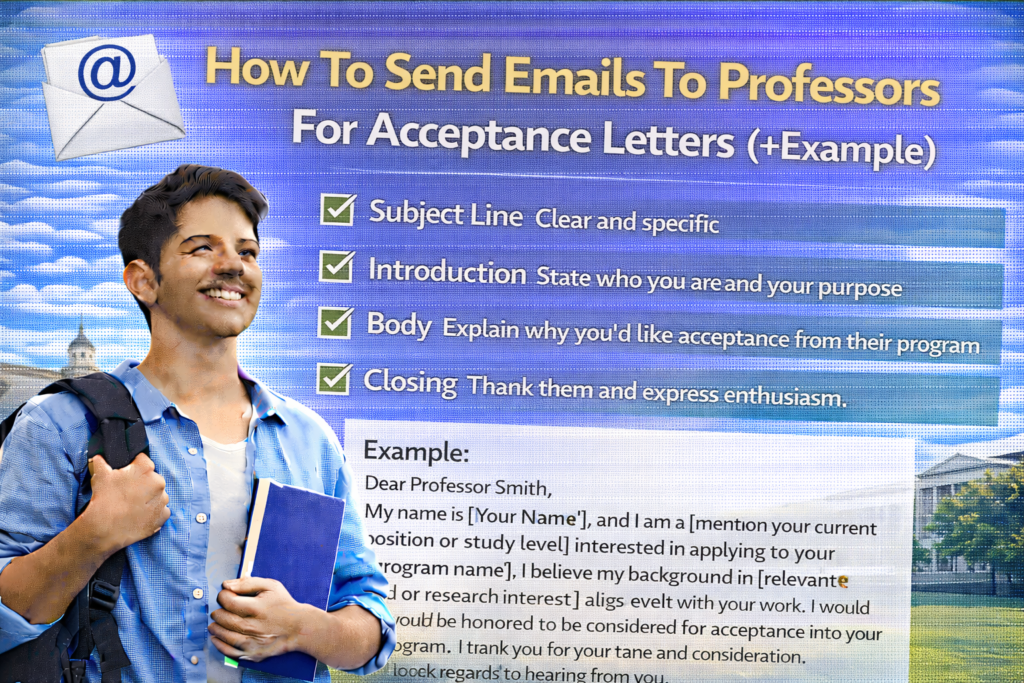
To maintain a professional flow in 2026, follow this informational structure. Avoid unnecessary horizontal lines and keep the tone balanced—respectful but confident.
I. The “Hook” Subject Line
Avoid vague titles. Your subject line should be a summary of your entire profile.
- Weak: Request for Acceptance.
- Strong: Prospective MS Student (9.0 CGPA) | Research Inquiry: [Professor’s Area] | [Your Name]
II. The Introduction
Introduce yourself with your full name and your current standing at SRM. State your purpose immediately: you are seeking their formal consent or an acceptance letter for a specific scholarship (e.g., MEXT or DAAD).
III. The “Why You?” Section
This is where you showcase your Unique Selling Points (USPs).
- Academic: Mention your specialization in AI and any high-grade core subjects.
- Professional: Highlight your work at upGrad and edbgo. Explain how you used data metrics (CTR, Reach) and web architecture (WordPress/Elementor) to solve problems. This shows you have “Real-World Grit.”
IV. The “Why Them?” Section
Show them you’ve read their work. “I was particularly inspired by your 2025 paper on [Topic]…” This proves you are a “Prospective Student” and not a “Spam Bot.”
V. The Call to Action
Politely ask for an interview or a brief 10-minute Zoom call. This is usually the precursor to receiving an official acceptance letter.
3. Formatting and Tone: The 2026 Standard
- Be Concise: Professors scan emails on mobile devices. Use short paragraphs and clear bullet points for your skills.
- Conversational yet Formal: Avoid “robotic” academic language. Phrases like “I would be thrilled to contribute” feel more human than “I hereby request consideration.”
- Active Voice: Instead of “Research was conducted by me,” use “I led a research project on…”
4. Sample Email for Acceptance Letter (AI Focused)
Subject: Prospective MS Student (SRM University) | Research Inquiry: [Specific Area] | [Your Full Name]
Dear Professor [Last Name],
I hope you are having a productive week. My name is [Your Name], and I am a final-year B.Tech student in Artificial Intelligence at SRM Institute of Science and Technology. I am writing to you because I am preparing my application for the [Scholarship Name] and am eager to seek your formal acceptance as my research supervisor for the Fall 2026 intake.
My academic focus has been on [Specific AI Subfield], where I have maintained a CGPA of [Your GPA]. Beyond my studies, I have gained significant professional experience as a Digital Marketing Intern at upGrad and an SEO Specialist at edbgo. These roles allowed me to apply my analytical mindset to large datasets, optimizing digital architectures and tracking ROI through complex metrics. I believe this “Full-Stack” approach to data and technology would allow me to contribute effectively to your lab’s work on [Professor’s Project Name].
I have followed your recent publications, particularly your work on [Topic], which aligns perfectly with my goal to research [Your Research Goal]. I have attached my CV and Transcripts for your perusal.
Would you be available for a brief virtual meeting next week to discuss how my background aligns with your current research priorities?
Thank you for your time and for the inspiring work you do at [University Name].
Sincerely,
[Your Name] [Phone Number] | [LinkedIn Link]