
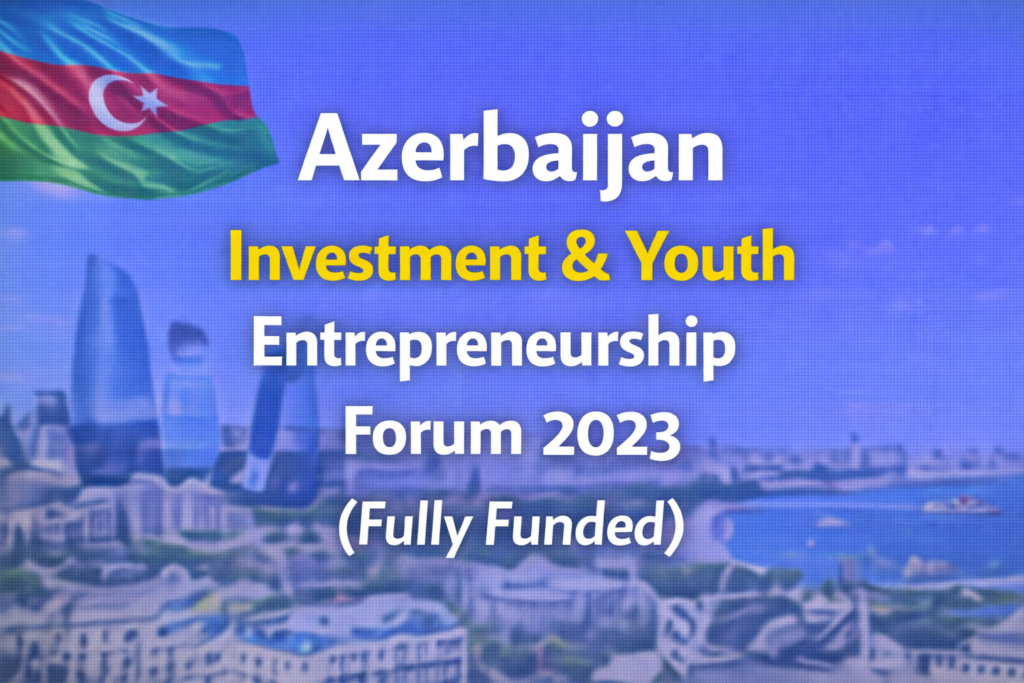
The Azerbaijan Investment and Youth Entrepreneurship Forum is a high-level global gathering designed to bridge the gap between young innovators and global capital. Co-organized by the Islamic Cooperation Youth Forum (ICYF) and the Small and Medium Business Development Agency (SMBDA) of Azerbaijan, the forum transforms Baku into a hub for the OIC (Organization of Islamic Cooperation) startup ecosystem.
While the text provided refers to past sessions, these forums are typically annual or biennial flagship events. For the upcoming cycle, the focus remains on empowering youth through sustainable development and technological innovation.
Forum Overview
| Feature | Details |
| Location | Baku, Azerbaijan |
| Organizers | ICYF & SMBDA |
| Target Group | Youth Entrepreneurs (Startups) |
| Core Themes | Investment, Ecosystem Development, Youth Empowerment |
| Financial Status | Fully Funded (for selected participants) |
Fully Funded Participation Benefits
The Organizing Committee provides a comprehensive “full-ride” package to ensure that financial barriers do not prevent top talent from reaching the forum.
- Travel Support: Full reimbursement or provision of round-trip international airfare to Baku.
- Accommodation: High-quality lodging provided for the duration of the forum.
- Meals: Full catering (breakfast, lunch, dinner) during the event.
- Visa Support: Official invitation letters and administrative help to secure an Azerbaijani visa.
- Global Exposure: The rare opportunity to pitch directly to Venture Capitalists (VCs), Angel Investors, and CEOs of top corporations.
Startup Verticals (Priority Sectors)
The forum specifically looks for startups operating in “Future-Proof” industries.
- Fintech & Smart Tech: Innovation in banking, digital payments, and IoT.
- Agri-Tech & Food-Tech: Solving food security challenges through technology.
- Green Industry & Renewable Energy: Sustainability and environmental tech.
- Robotics and AI: Automation and advanced computing.
- Aviation & Space Tech: Cutting-edge aerospace innovation.
- Logistics & Smart City: Improving urban efficiency and supply chains.
- Games and Applications: Creative digital industries.
Eligibility Criteria
To be considered for the forum, applicants must meet the following strict standards:
- Nationality: Must be from an OIC Member State or represent a Muslim minority in a Non-OIC country.
- Age Limit: Entrepreneurs must be between 18 and 35 years old.
- Language: Proficiency in English is mandatory, as all panels and pitch sessions are conducted in English.
- Startup Stage: While open to various levels, preference is given to startups with a Minimum Viable Product (MVP) or an innovative prototype ready for showcase.
The Forum Experience: What to Expect
- The Pitch Deck: Selected startups will showcase their innovations in a specialized exhibition area.
- Roundtable Discussions: Closed sessions between youth leaders and government officials to discuss policy changes that support entrepreneurship.
- Networking: Structured sessions to meet potential partners from the Eurasia and OIC regions.
- Cultural Events: Immersion into the rich heritage of Azerbaijan, known as the “Land of Fire.”
How to Apply: Step-by-Step
- Online Registration: Applications are typically processed through the official ICYF website.
- Submit Pitch Deck: You must upload a professional pitch deck detailing your problem, solution, market size, and business model.
- Vertical Selection: Choose one of the 9 priority verticals listed above.
- Await Selection: Due to high volume, only shortlisted startups are contacted for the next stage (usually a virtual interview).
Statistics: OIC Startup Ecosystem
- The OIC Region: Comprises 57 countries with a combined population of over 1.9 billion people.
- Youth Demographic: Over 60% of the population in OIC countries is under the age of 30, representing one of the world’s largest untapped pools of entrepreneurial talent.
- Azerbaijan’s Growth: Azerbaijan has seen a 20-30% annual increase in the number of registered startups over the last five years, driven by government incentives and the “ASAN” service model.