
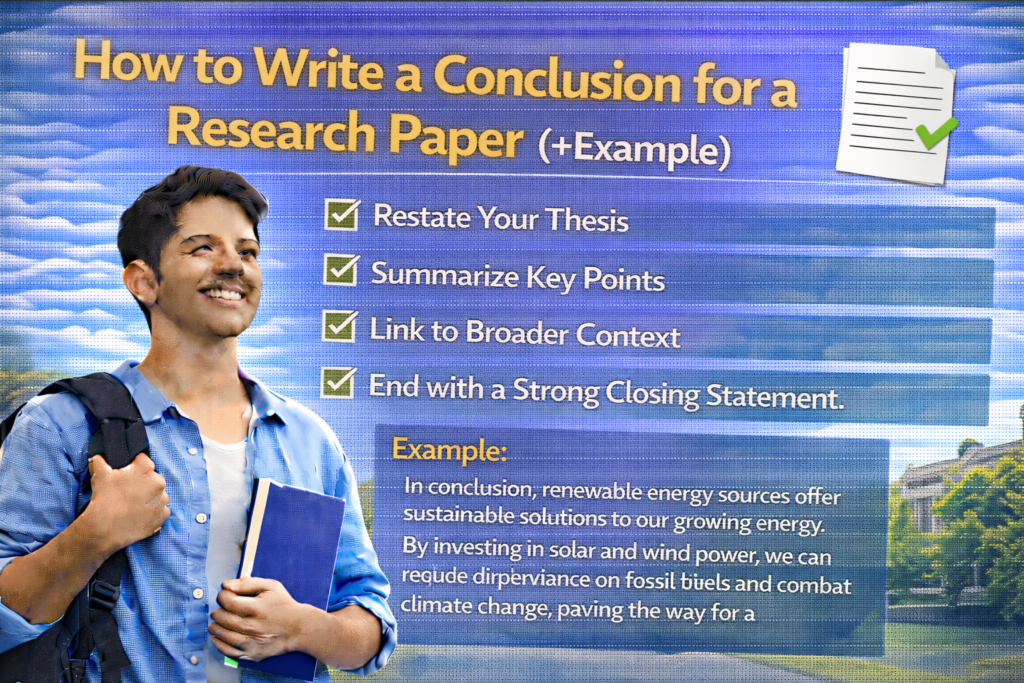
Writing a solid research paper conclusion is more than just “ending” the document; it is about wrapping up your intellectual journey and showing the reader why your work actually matters. For a student like you—pursuing B.Tech in Artificial Intelligence at SRM—the conclusion is where you shift from complex technical data to the real-world impact of your AI models or digital strategies.
In 2026, research is judged not just on its accuracy, but on its application. This guide provides a detailed, informational breakdown of how to structure a conclusion that leaves a lasting impression, organized into the FAQ-style segments you prefer.
1. What is the True Purpose of a Conclusion?
The conclusion is the “final word” on your research. It provides closure and ensures the reader understands the “So What?” of your study.
- Synthesize, Don’t Just Summarize: Don’t just list what you did; explain how all your points fit together to support your main goal.
- Create Impact: It’s your last chance to convince the reader (or a scholarship committee) that your research in AI or Marketing is significant.
- The Full Circle: A good conclusion returns to the questions you asked in the introduction, proving that you have successfully navigated the “labyrinth of knowledge.”
2. The Core Building Blocks of a 2026 Conclusion
To ensure your ending is professional and persuasive, follow this logical structure:
I. Restate the Research Problem Briefly remind the reader why you started this study. If your paper was about using AI to optimize SEO at upGrad, restate the challenge of digital visibility in a crowded market.
II. Rephrase the Thesis Statement Revisit your main argument, but do not use the same words as the introduction. Provide a “fresh” perspective based on the data you’ve just presented.
III. Summarize Key Findings Highlight the most important results. For instance, “The study confirmed that integrating Generative AI into content scheduling reduces operational time by 30%.”
IV. Acknowledge Limitations Honesty is the hallmark of a great researcher. Mention any constraints, such as sample size or data availability, and explain why they don’t invalidate your results.
V. Suggest Future Research Open the door for others. How can another student at SRM build on your AI model? What’s the next step for digital marketing automation?
3. Emphasizing Importance and Providing a “Call to Action”
In 2026, “Passive” research is out; “Actionable” research is in.
- The Significance: Explain how your work adds to the existing body of knowledge. Does it fill a gap in AI ethics? Does it provide a new framework for SEO?
- The Call to Action: Encourage the reader to apply your findings. If your research showed that certain AI models are biased, your call to action might be a plea for more transparent data sets.
4. What to Avoid in Your Conclusion
- New Information: Never introduce a new variable or a new argument in the last paragraph. It confuses the reader and ruins the flow.
- Vague Jargon: While you are an AI expert, the conclusion should be readable by a wider audience. Use clear, direct language.
- Apologetic Tone: Avoid phrases like “I might be wrong” or “This is just my opinion.” Stand by your data.
5. Writing a Research Paper Conclusion: Example (AI Focused)
“In conclusion, this research has successfully analyzed the impact of [Topic, e.g., Automated Content Generation] on [Specific Field, e.g., Digital Marketing ROI]. By implementing a Neural Network-based approach, our study demonstrated a significant correlation between algorithmic efficiency and consumer engagement.
The findings confirm that while traditional methods are becoming obsolete, the integration of [Your Specific AI Model] offers a deeper understanding of market trends. These insights provide a practical roadmap for stakeholders at organizations like upGrad or edbgo to make informed, data-driven choices.
However, certain methodological constraints regarding data diversity must be acknowledged. These limitations provide a clear avenue for future researchers to expand this work by incorporating cross-cultural datasets. Ultimately, this paper contributes to the field of Artificial Intelligence by proving that when technology is used ethically and strategically, it doesn’t just automate tasks—it elevates human creativity.”
Frequently Asked Questions (FAQ)
How long should the conclusion be? Generally, a conclusion should be about 10% of your total paper length. For a standard 10-page paper, a one-page conclusion is perfect.
Can I use “I” in the conclusion? In many technical AI papers, the “third person” (e.g., “The study shows…”) is preferred. However, if you are adding a “Personal Reflection” section, using “I” can add a human touch.
Should I include citations in the conclusion? Ideally, no. Citations belong in the body. The conclusion should be your own synthesis of the information.
How is a conclusion different from an abstract? An Abstract is a preview (summary of everything); a Conclusion is a review (synthesis of what happened and what it means for the future).