
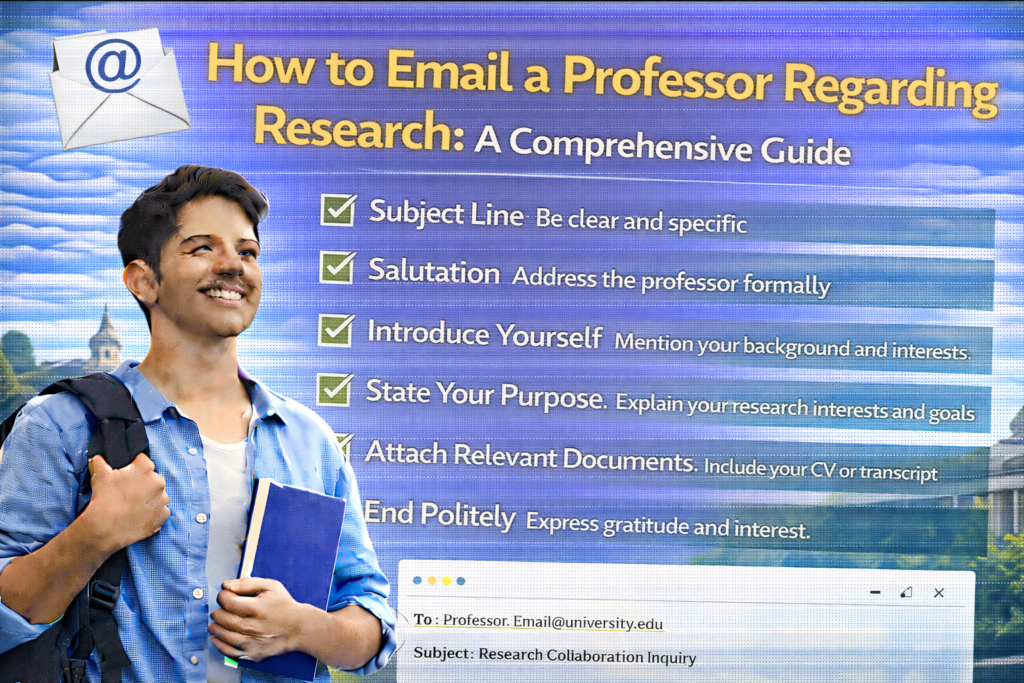
In the academic world of 2026, the “cold email” remains the most powerful tool for securing a research position. For a student like you—currently at SRM specializing in Artificial Intelligence—your goal is to move beyond a generic inquiry and prove that you are a technical asset. Whether you are targeting a lab at the University of Tokyo or a digital innovation hub in Europe, your email must demonstrate that you have done your homework.
This guide provides a structured, informational breakdown to help you master the art of the research inquiry, organized into the FAQ-style segments you prefer.
1. Why is the “Pre-Email” Research Phase Mandatory?
Professors can spot a “copy-paste” email in seconds. Before you even open your inbox, you must understand the professor’s world.
- The Deep Dive: Don’t just look at their title. Explore their Google Scholar citations and the “Current Projects” section of their lab website.
- The Connection: Identify one specific paper or finding that resonates with your work in AI or your experience at upGrad/edbgo.
- The Fit: Ask yourself: “How does my background in Neural Networks or SEO analytics solve a problem they are currently working on?”
2. Crafting the “Scroll-Stopping” Subject Line
The subject line is your only chance to get a busy professor to click “Open” instead of “Delete.” It should be information-dense and professional.
- Weak Subject Lines: “Research Question,” “Hello,” or “Internship Request.”
- Strong Subject Lines: “Inquiry regarding MS Research: [Specific Topic] – [Your Name]” or “Prospective PhD Student: [Your University] AI Background.”
- The “Pro” Move: Mentioning a specific paper in the subject line (e.g., “Question regarding your 2025 paper on GANs”) almost guarantees an open.
3. The Structural Roadmap of a Research Email
To maintain a professional flow, organize your email into clear, concise segments.
I. The Formal Salutation
Always use “Dear Professor [Last Name]” or “Dear Dr. [Last Name].” Using “Mr.” or “Ms.” can be seen as a sign that you haven’t researched their academic standing.
II. The Engaging Introduction
Briefly introduce yourself: your name, your degree at SRM, and your core area of interest. Immediately follow this with why you are emailing them specifically. Mention a specific publication or project of theirs that inspired you.
III. Showcasing Your Technical “Grit”
This is where you mention your qualifications.
- Academic: Your 9.0+ CGPA and B.Tech AI specialization.
- Professional: Your work at upGrad managing Meta Ads data or at edbgo handling web architecture. This proves you are comfortable with real-world technical execution.
IV. Explaining Your Intentions
Clearly state what you are looking for. Are you seeking a Master’s thesis supervisor? A summer research internship? Be transparent about your goals and why their mentorship is the missing piece of your puzzle.
V. The Call to Action & Professional Sign-off
Don’t just say “I hope to hear from you.” Ask for a specific, low-commitment next step. “Would you be available for a 10-minute virtual chat next week to discuss potential alignment?”
4. Essential “Don’ts” for 2026 Academic Emails
- Don’t use Jargon: While you are an AI student, keep the language clear. Don’t use “slang” or overly complex abbreviations that are specific only to your current college.
- Don’t Flatter Excessively: Professors value genuine interest over empty praise. One specific reference to their work is better than three sentences of “I am your biggest fan.”
- Don’t Forget the Attachments: Always attach your Academic CV and Unofficial Transcripts as PDFs. Never send them as links to a Google Drive that might require permission.
5. Sample Research Inquiry Template (AI Focused)
Subject: Inquiry regarding Research Opportunities in [Professor’s Area] – [Your Name]
Dear Professor [Last Name],
I hope this email finds you well. My name is [Your Name], and I am currently a final-year B.Tech student in Artificial Intelligence at SRM Institute of Science and Technology. I have followed your research on [Specific Topic] with great interest, particularly your recent work in [Mention a Paper/Project].
My academic background has provided me with a solid foundation in [Skill 1] and [Skill 2]. Beyond the classroom, I have applied these skills during my internships at upGrad and edbgo, where I gained experience in data-driven decision-making and managing complex digital infrastructures. I am particularly intrigued by how your lab integrates [Specific Method] and would welcome the opportunity to contribute to your ongoing research as a [MS/PhD/Intern] student.
I have attached my CV and transcripts for your review. Would you be open to a brief meeting next week to discuss potential collaboration or opportunities within your research group?
Thank you for your time and for your inspiring contributions to the field.
Sincerely,
[Your Name] [Phone Number] | [LinkedIn Profile]
Frequently Asked Questions (FAQ)
How long should I wait for a reply? Give it 7 to 10 days. Professors are often traveling or at conferences. If you don’t hear back, send one polite follow-up nudge.
Should I email multiple professors in the same department? Yes, but one at a time. Wait for a response (or a week to pass) before moving to the next person in the same department to avoid looking like you are “spamming” the faculty.
Is it okay to mention that I’m looking for a scholarship? In the first email, focus on the Research. If the professor is interested in your profile, the conversation about funding and scholarships will naturally follow in the second or third interaction.