
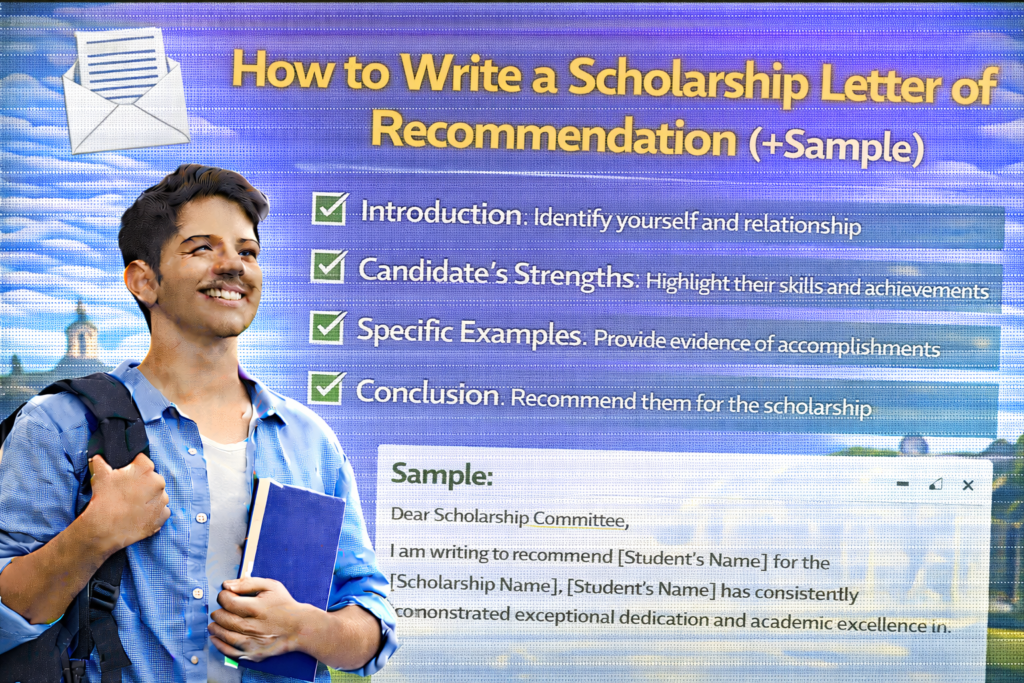
In the world of 2026 scholarship applications, a Letter of Recommendation (LOR) is the third-party validation that turns a good application into a winning one. While your transcripts prove you have the “grades,” the LOR proves you have the “character.” For a student like you—pursuing B.Tech in Artificial Intelligence at SRM while working at upGrad and edbgo—a strong LOR from a professor or supervisor acts as a bridge, connecting your technical skills to your real-world leadership.
The following guide breaks down the essential components and strategies for securing and crafting a high-impact recommendation, organized into the informational FAQ segments you prefer.
1. Why is the Recommendation Letter So Important?
Scholarship committees often feel like they are looking at a sea of identical high GPAs. The LOR is the primary tool they use to differentiate candidates.
- Character Insight: It provides a human perspective on your work ethic, integrity, and resilience.
- Validation: It confirms the claims you made in your SOP or motivation letter.
- Future Potential: It offers an expert’s opinion on your likelihood of success in a graduate-level research environment or a global professional role.
2. The Role of the Recommender: Who Should You Choose?
Choosing the right person is as important as what they write. In 2026, committees look for a “Deep Connection” rather than just a “High Title.”
- The Academic Recommender: A professor at SRM who has taught you core AI or Data Science subjects. They can speak to your analytical grit.
- The Professional Recommender: Your supervisor at upGrad or edbgo. They can validate your ability to apply AI tools in digital marketing and manage complex web projects.
- The Mentor: Someone who has seen you lead a community project or a student club.
3. Key Elements of an Impactful Letter
To move from a generic letter to an outstanding one, the recommender should include these specific building blocks:
- The Context: A brief introduction of how long they’ve known you (e.g., “I have mentored Jayasuriya for three semesters…”).
- Evidence-Based Praise: Instead of saying “He is smart,” they should say “He successfully optimized a keyword strategy that increased organic traffic by 25%.”
- Alignment with Scholarship: The letter should mention why the student is a perfect fit for that specific award (e.g., a Japanese research grant or an Erasmus Mundus scholarship).
- Resilience: If you overcame a technical hurdle in a project, the recommender should highlight how you handled that pressure.
4. Tips for Writing (or Requesting) the Letter
If you are asking a professor or supervisor for a letter, you can make their job easier by providing a “Cheat Sheet.”
- Tailor it: Don’t use a one-size-fits-all approach. Each letter should address the specific goals of the scholarship.
- Be Specific: Use anecdotes. Concrete evidence adds massive credibility.
- Professional Tone: Ensure the letter is on an official institutional letterhead with a professional signature.
- Advance Notice: Give your recommender at least 3-4 weeks. Quality writing takes time.
5. Common Mistakes to Avoid
- Being Vague: Generic phrases like “He is a good student” are meaningless to a committee.
- Lack of Detail: Failing to provide specific examples of leadership or technical growth.
- Over-the-Top Praise: Insincere or exaggerated praise can actually hurt your chances. Balance is key.
Sample Scholarship Letter of Recommendation (Academic/Technical)
To the Scholarship Selection Committee,
It is a privilege to recommend [Your Full Name] for the [Scholarship Name]. As a Professor of [Department] at SRM Institute of Science and Technology, I have had the opportunity to observe his academic growth and technical proficiency over the past two years, specifically in my [Subject Name] courses.
[Student’s Last Name] consistently ranks among the top 5% of his cohort. What sets him apart is his ability to apply theoretical AI concepts to practical challenges. During our lab sessions on Neural Networks, he demonstrated a remarkable aptitude for [mention a specific technical skill or project result].
Beyond his academic success, he is a dedicated professional who has successfully balanced a rigorous B.Tech curriculum with high-impact internships. His work in digital marketing and web specialization shows a rare “interdisciplinary” mindset that is essential for the modern tech landscape. I am confident that with the support of the [Scholarship Name], he will continue to make significant contributions to the field of Artificial Intelligence.
Sincerely,
[Professor’s Name] [Title/Position] [SRM Institute of Science and Technology]