
A motivation letter is your chance to tell the story that your grades and CV cannot. In the academic world of 2026, where technical fields like Artificial Intelligence are rapidly evolving, scholarship committees look for more than just “smart” students—they look for students with a clear “mission.”
Whether you are applying for a MEXT scholarship in Japan or an Erasmus Mundus in Europe, your motivation letter should bridge the gap between your technical foundation at SRM and your professional impact at upGrad and edbgo.
1. The Core Purpose: Why are you a “High-Value” Candidate?
The motivation letter isn’t just about why you want the scholarship; it’s about why the scholarship provider needs you.
- Alignment: How do your personal values match the mission of the organization?
- Suitability: Do you have the specific background (like your B.Tech in AI) to succeed in their program?
- Potential: How will you use their funding to create a “Return on Investment” for society?
2. Research-Driven Personalization
Before writing, you must look beyond the scholarship’s name. Research the provider’s recent initiatives.
- Themes: If the provider focuses on “Digital Transformation,” highlight your SEO and web specialist experience.
- Geography: If it’s a Japanese scholarship, mention your admiration for their automation culture and your desire to bring that knowledge back to India.
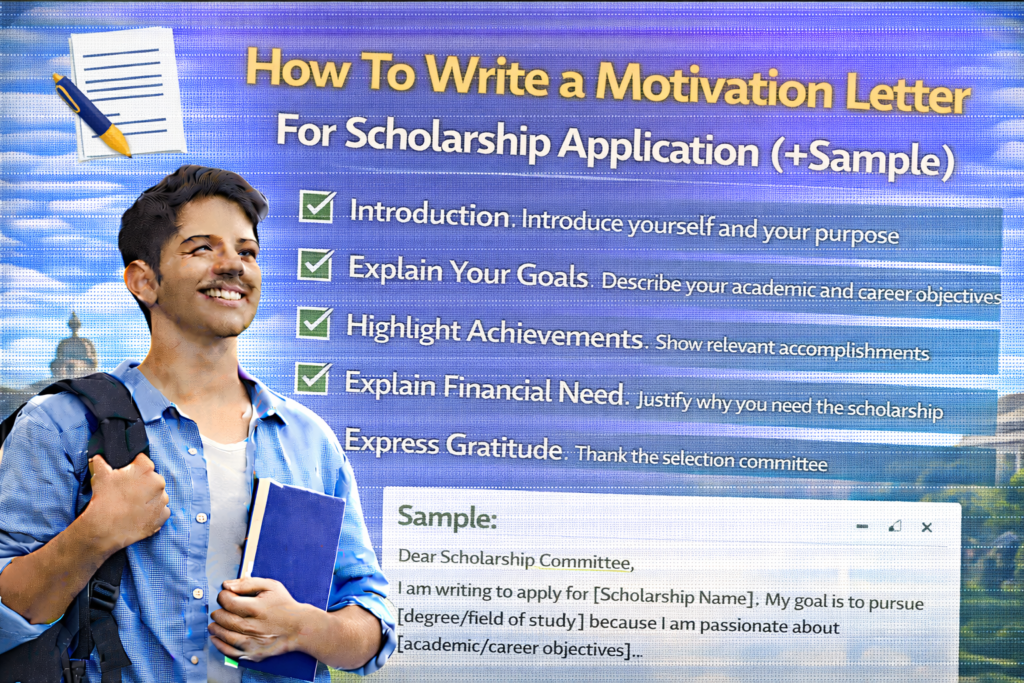
3. The 5-Part Structural Roadmap
To keep your letter impactful and easy to read, follow this informational structure:
I. The Captivating Introduction
Avoid starting with “My name is…” Instead, start with an observation or a brief story.
- Example: “In the digital age, data is often called the new oil, but without the right algorithms, it is just noise. This realization during my AI studies at SRM sparked my journey…”
II. Showcasing Technical & Professional Grit
Use your background to prove your readiness.
- Academic Achievement: Mention your CGPA and core AI coursework.
- Professional Milestones: Discuss your work at upGrad. Explain how you didn’t just manage social media, but used data metrics to improve reach and engagement. This shows you are a “Full-Stack” professional.
III. The Connection to Your Field (AI + Marketing)
Explain your “Unique Selling Point.” As an AI student with digital marketing experience, you occupy a rare niche. Talk about how you want to use AI to make digital ecosystems more efficient and user-centric.
IV. Future Goals and Societal Impact
Where will you be in 2030?
- The Vision: “I aim to develop ethical AI frameworks that empower small-scale entrepreneurs to compete in global markets.”
- The Impact: Show that you aren’t just seeking a degree for a high salary, but to solve real problems.
V. Gratitude and Professional Closing
End with humility and a strong “Call to Action.” Reiterate that this scholarship is the final catalyst you need to turn your aspirations into reality.
4. Motivation Letter Sample (Personalized for 2026)
Dear Scholarship Committee,
I am writing to express my profound interest in the [Scholarship Name]. As a final-year B.Tech student in Artificial Intelligence at SRM Institute of Science and Technology, I have spent my academic career mastering the logic of machines. However, it was my work in the professional sphere—interning at upGrad and edbgo—that taught me how these machines can truly serve humanity.
My academic performance, maintained at a [Your GPA] CGPA, has provided me with a robust foundation in Neural Networks and Automation. Yet, I am not a researcher who stays confined to the lab. During my time as an SEO & Web Specialist at edbgo, I realized that technical excellence must be matched by strategic communication. I successfully managed complex web architectures, bridging the gap between back-end logic and front-end user experience.
At upGrad, I took this a step further by using AI tools to optimize social media marketing and Meta Ads. This intersection of AI and Digital Marketing is where I intend to build my career. I am eager to pursue a Master’s degree in [Specific Field] because I want to research how Generative AI can be democratized for small business owners in developing economies.
The [Scholarship Name] represents more than just financial aid; it is a vote of confidence in my vision to create a more equitable digital world. I am committed to bringing the same level of diligence and innovation to your university that I have brought to my studies at SRM and my professional roles.
Thank you for your time and for the opportunity to share my journey with you. I look forward to the possibility of contributing to your academic community.
Sincerely,
[Your Name]
5. Frequently Asked Questions (FAQ)
How long should it be? The “sweet spot” is usually one to one and a half pages (about 600–800 words). If it’s too short, you lack depth; if it’s too long, the committee might skip sections.
Should I use “I” or stay in the third person? Always use “I.” This is a personal statement. Third-person language makes you sound detached from your own achievements.
Is it okay to mention my hobbies? Only if they relate to your field or show a key trait like “persistence” (e.g., long-distance running or learning a new language).
What is the most common mistake? Using a generic template. Committees can tell within the first sentence if you’ve copied a letter from the internet. Be authentic.