
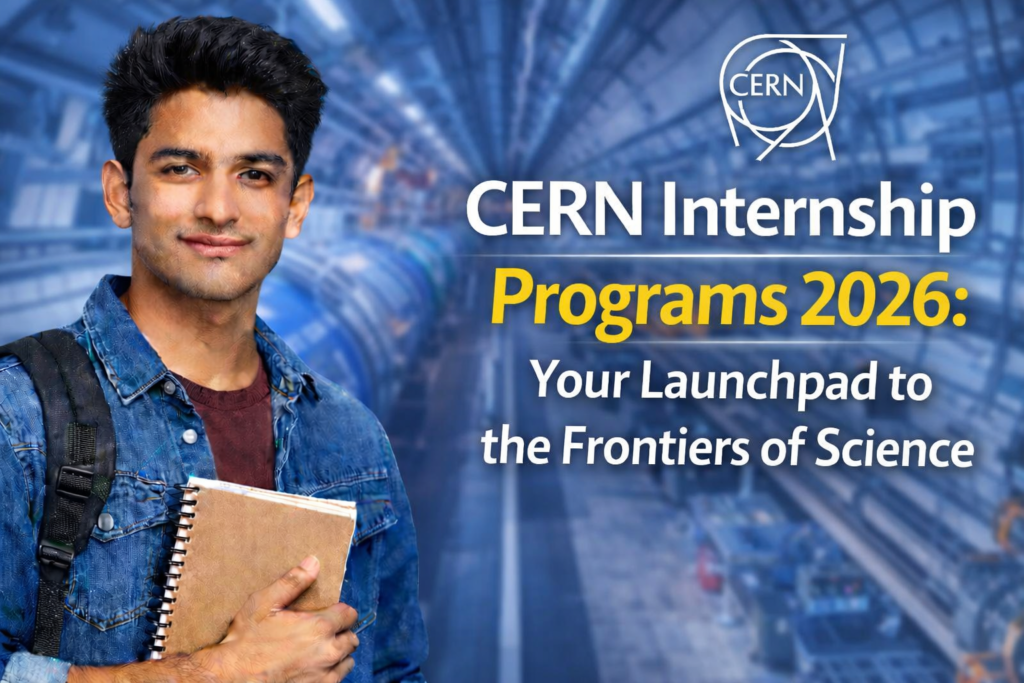
The CERN Internship Programs 2026 offer a rare, fully funded gateway into the world’s most advanced particle physics laboratory. Located on the Franco-Swiss border near Geneva, CERN is not just for physicists; it is a high-tech city that requires the best engineers, computer scientists, and administrative minds to keep the “Big Bang machine” running.
Whether you are interested in a short-term practical stay or a long-term technical project, CERN has a specific path for you. This guide explores the 2026 intake, including the competitive stipends, the world-class mentorship, and the application secrets you won’t find on the official brochures.
Why Intern at CERN in 2026?
CERN is a unique environment where technical challenges are met with unprecedented computing power. For students, the benefits are life-changing:
1. Financial Support & Stipend
CERN ensures its interns can live comfortably in Geneva, one of the world’s most expensive cities.
- Monthly Allowance: For the 2026 Short-Term Internship, students receive approximately 1,593 Swiss Francs (CHF) per month.
- Technical Student Stipend: For those on the longer Technical Studentship track, the stipend is much higher, around 3,486 CHF per month (tax-free).
- Travel and Insurance: CERN often provides travel subsidies and health insurance coverage, depending on the specific program you join.
2. Hands-On with “Big Data”
If you are an AI or Computer Science student, CERN is your playground. You will work with the Worldwide LHC Computing Grid (WLCG), which handles over 1 exabyte of data. From training machine learning models to identify particle tracks to optimizing distributed systems, the technical experience here is decades ahead of the industry standard.
3. Global Collaboration
CERN is a “Member State” organization. You will work in a multicultural environment with experts from over 100 countries. This isn’t just about science; it’s about diplomacy and building a global professional network.
Understanding the Different CERN Programs
CERN offers several distinct “flavors” of internships. It is crucial to pick the one that fits your academic year and nationality.
1. The Short-Term Internship (1–6 Months)
This is a flexible, year-round program ideal for undergraduate students looking for a practical training period.
- Focus: Applied physics, computing, engineering, or administration.
- Key Advantage: It is a “spontaneous” application, meaning you can apply at any time.
2. The Technical Student Program (4–12 Months)
This is a more intensive program, often used by students to complete their final year project or Master’s thesis.
- Fields: IT, Mathematics, Robotics, Electrical/Electronics, and Mechanical Engineering.
- Eligibility: You must have completed at least 18 months of your undergraduate studies.
3. CERN openlab Summer Program (9 Weeks)
This is the “special forces” track for Computer Science and AI students.
- The Experience: You work on cutting-edge ICT projects (like Quantum Computing or AI-enhanced operators) with industry partners like Google, Intel, and Oracle.
- The Singapore Symposium: Openlab students often participate in specialized workshops and even global symposia.
Eligibility Criteria for 2026
To be a competitive applicant, you must meet the following baseline requirements:
- Academic Status: You must be a full-time student pursuing a Bachelor’s or Master’s degree. For most programs (except openlab), you must be a national of a CERN Member or Associate Member State.
- Language Skills: You must be proficient in English or French. Knowledge of both is a major plus but not mandatory.
- Age: You must be at least 18 years old at the time of application.
[!NOTE] Important for Indian Students: India is an Associate Member State of CERN. This means you are fully eligible for the Technical Student Program and the openlab Summer Program!
Required Documents: A Checklist for Success
CERN’s selection process is highly structured. You will need:
- A Modern CV: Use a clean, technical format. Highlight specific coding languages (C++, Python), hardware skills, or administrative tools.
- Academic Transcript: A recent copy of your official university grades.
- Letter of Reference: A signed letter from a professor or a previous supervisor. For the Technical Student program, you may need two.
- Proof of Enrollment: A certificate from your university confirming you are a current student.
How to Apply: The Strategic Roadmap
Applying to CERN is a “matching” process. The HR team doesn’t hire you; a specific supervisor in a lab chooses you.
Step 1: The Online Profile
Create a profile on the CERN Careers portal (SmartRecruiters). Ensure your technical skills are clearly tagged, as supervisors often search for keywords like “TensorFlow,” “FPGA,” or “Kubernetes.”
Step 2: The “HireVue” Interview
If you are shortlisted for the Technical or Administrative programs, you may be invited to an asynchronous video interview (HireVue). You will be asked situational questions—be prepared to discuss how you handle technical roadblocks.
Step 3: The Availability Period
For the Short-Term Internship, you must specify your availability. Be flexible! Choosing a period during the “off-season” (January–April) can sometimes increase your chances as there is less competition than in the summer.
Life in Geneva: What to Expect
Geneva is a beautiful, international city situated on the shores of Lake Geneva.
- The CERN Hostel: Many interns stay at the on-site hostel, which is a great way to meet peers.
- Biking & Hiking: The area is perfect for outdoor enthusiasts. You can bike from France to Switzerland in 15 minutes!
- The Work Culture: CERN has a “no-tie” culture. It is collaborative, casual, but intellectually intense. Expect to have long coffee breaks where the best scientific ideas are often born.
Pro-Tips for AI and Engineering Students
- Emphasize “Scalability”: In your CV, show that you understand how to work with large systems. CERN doesn’t just do AI; they do AI at Petabyte scale.
- Highlight Open Source: If you have contributed to GitHub projects or used mainstream technologies like Docker or Kafka, make that prominent.
- Tailor Your Motivation: Don’t just say you like physics. Explain how your specific skill (e.g., “Automating TLS certificates” or “FPGA design”) helps CERN achieve its mission.
- The “Referral” Factor: While the official process is online, reaching out to a CERN researcher whose work you admire (via LinkedIn or professional email) to ask about potential projects is a legitimate and often successful strategy.
Conclusion
The CERN Internship Program 2026 is more than just a summer job; it is an immersion into the engine room of modern science. Whether you are building the next generation of particle detectors or managing the complex logistics of an international organization, CERN offers a professional experience that is simply out of this world.
Your journey to the heart of the universe starts now! The Short-Term Internship applications are open year-round, so don’t wait. Prepare your CV, secure your reference letter, and apply today.