
The NATO Internship Programme 2026 is now open for applications. This program offers a fully supported, six-month placement in Brussels, Belgium, providing an unparalleled opportunity to work alongside top diplomats and military experts.
As NATO continues to evolve in the face of modern threats—ranging from cyberwarfare to climate security—the alliance is looking for fresh perspectives from the next generation of leaders. This guide provides a comprehensive roadmap to securing a spot in the 2026 cycle.
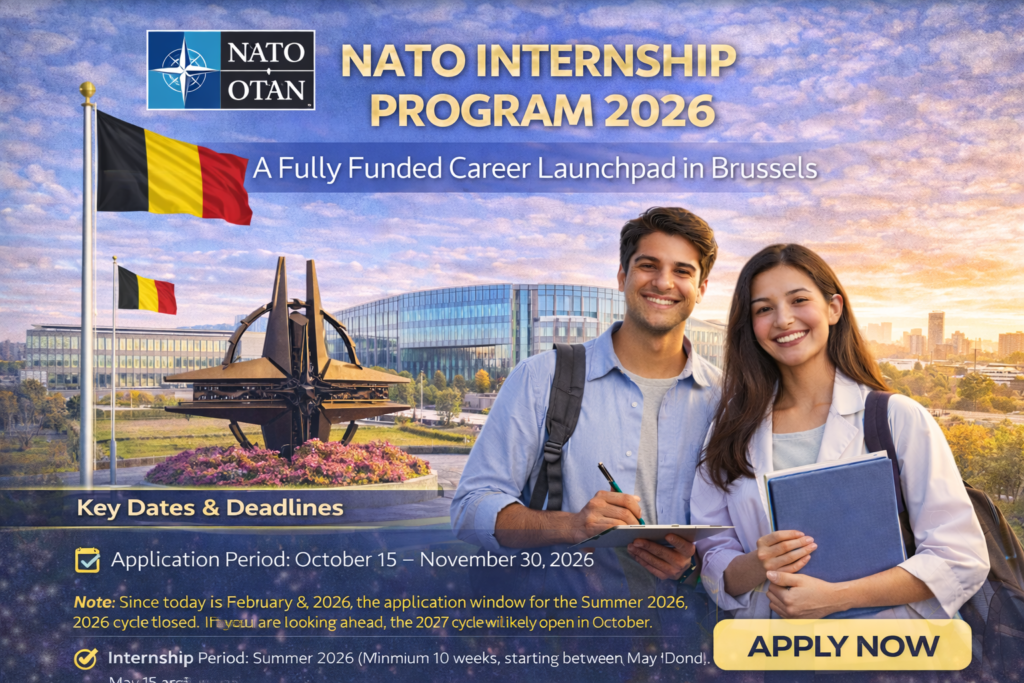
What is the NATO Internship Programme?
The NATO Internship is a professional development initiative designed to bring diverse talent into the alliance’s International Staff (IS) and International Military Staff (IMS). Unlike typical “shadowing” internships, NATO interns are treated as junior staff members. You will be assigned real tasks, contribute to policy papers, and participate in high-level briefings that shape global security.
For 2026, the program is placing a heavy emphasis on emerging and disruptive technologies (EDTs), making it a golden opportunity for STEM students and AI specialists.
Why Apply for NATO in 2026? (The Major Benefits)
NATO ensures that its interns are well-compensated and professionally supported during their six months in Brussels.
1. Financial Support Package
- Monthly Stipend: For the 2026 cycle, the stipend is approximately EUR 1,286 per month. This is designed to cover your housing, food, and daily transportation in Brussels.
- Travel Reimbursement: NATO provides a return economy-class ticket (or car travel reimbursement) from your home country to Brussels, up to a maximum of EUR 1,200.
- Paid Leave: You are entitled to 15 days of paid leave over the six-month period, allowing you time to explore Europe.
2. High-Level Training & Induction
Every intern participates in an extensive induction program. This includes monthly briefings with NATO Ambassadors, visits to the European Parliament, and workshops on international negotiation and security protocol.
3. Career Networking
Brussels is the “Capital of Europe.” During your internship, you will build a network of mentors and peers from 32 different nations, creating professional links that are invaluable for a future career in the UN, EU, or national governments.
Participating Departments: Where Do You Fit In?
NATO is much more than just a military force. Its headquarters operates like a small city with departments covering almost every professional field.
| Division | Focus Areas for 2026 |
| Cyber and Digital Transformation | AI policy, cloud security, and digital infrastructure. |
| Political Affairs & Security Policy | International relations, arms control, and regional security. |
| Innovation, Defence & Armaments | Next-gen weaponry, tech scouting, and industry engagement. |
| Operations | Disaster response, mission planning, and maritime security. |
| Executive Management | HR, Finance, ICT, and Legal services. |
| Public Diplomacy | Communications, social media, and digital storytelling. |
Detailed Eligibility: The “Strict Membership” Rule
The most critical eligibility factor is your citizenship. To apply, you must be a citizen of a NATO member country.
1. Nationality
As of 2026, NATO has 32 member countries, including newest members Finland and Sweden.
[!CAUTION]
Important Note for Your Profile: Since you are currently studying at SRM in India, it is important to note that India is not a NATO member. Therefore, you would not be eligible for the core Brussels internship unless you hold dual citizenship with a member nation (like the USA, UK, Canada, or any European member).
However, if you are interested in security, I can help you find “Partner Country” internships through the Indian Ministry of External Affairs or specific security fellowships in member nations.
2. Academic Requirements
- Undergraduate Students: You must be enrolled in at least the 3rd year of your degree.
- Recent Graduates: You are eligible if you graduated within the last 12 months.
- Age: You must be 21 years or older at the time of application.
The Security Clearance Process: A Crucial Hurdle
If you are selected, you cannot start until you receive a NATO Secret Security Clearance.
- The Process: This is handled by your national government (not NATO). They will review your background, residency, and criminal record.
- The Timeline: This can take anywhere from 6 to 8 months. This is why NATO opens applications so far in advance. If your clearance is delayed, NATO often allows you to postpone your start date.
Required Documentation Checklist
All documents must be in either English or French (NATO’s two official languages).
- One-Page CV/Resume: Do not exceed one page. Use a clear, professional layout (Europass or NATO-specific).
- Motivation Letter: A one-page essay explaining why you want to work for the Alliance and how your skills fit a specific department.
- Proof of Enrollment/Degree: A scan of your highest degree or a letter from your university registrar.
- Proof of Citizenship: A copy of your passport.
How to Apply: The TALEO Portal Roadmap
NATO uses the TALEO e-recruitment system. Follow these steps:
- Register: Create an account on the NATO Careers Portal.
- The Online Assessment (HireVue): Shortlisted candidates are invited to an online assessment. This involves “business games” (logic and situational tests) and a recorded video interview.
- The Interview: If you pass the assessment, you will be invited for a live interview with the hiring manager of your chosen department.
- The Offer: Successful candidates receive a Conditional Offer, which only becomes official once the security clearance is granted.
Key Deadlines for the 2026 Cycle
- Application Window: Opens in April/May 2025 and closes in June 2025.
- Selection Decisions: Made between July and September 2025.
- Intake Periods: Successful candidates usually start in either March 2026 or September 2026.
Expert Tips for Success
- Tailor Your AI Skills: If you are an AI student, emphasize your knowledge of Algorithm Ethics and Cyber Resilience. NATO is currently drafting guidelines for the responsible use of AI in defense.
- Multilingualism Matters: While only English or French is required, knowing a second NATO language (like German, Spanish, or Turkish) is a significant advantage.
- Focus on Core Values: In your motivation letter, mention the Washington Treaty and your commitment to collective defense and democratic values.
- Prepare for the “Business Games”: Use the HireVue practice sessions. These games measure your “cognitive agility” and how you react under pressure.
Conclusion
The NATO Internship 2026 is more than just a CV booster; it is a launchpad into the world of high-level international affairs and security. By providing a generous stipend and a platform to work on the world’s most pressing security challenges, NATO is preparing the next generation of leaders to protect a billion people.
Start preparing your documents early! Since the window for 2026 applications opens this Spring, now is the time to refine your resume and research the specific NATO bodies that match your career goals.