
Are you an undergraduate student in an LMIC (Low or Middle-Income Country) with a passion for genomics, bioinformatics, or medicine? The Sanger Prize Competition 2026 is now open, offering a life-changing opportunity to win a fully funded three-month internship at the Wellcome Sanger Institute in Cambridge, United Kingdom.
Unlike many other programs that rely solely on grades or university rankings, the Sanger Prize is a true “meritocracy.” It uses an essay-based competition to find the most motivated and innovative young minds in science today. If you have ever dreamed of conducting research at the very place that helped sequence the first human genome, this is your chance.
What is the Sanger Prize?
The Sanger Prize is an international outreach initiative named after Frederick Sanger, the father of genomics. It is hosted by the Wellcome Sanger Institute, a leader in genomic research worldwide.
The prize is specifically reserved for students who live and study in low- and middle-income countries. The goal is to identify talented individuals who have the potential to become future leaders in genomics but may currently lack access to the advanced laboratory equipment and computational resources found in high-income countries.
Why Win the Sanger Prize? (Key Benefits)
The winner of the 2026 Sanger Prize receives a comprehensive financial and professional package that covers every aspect of their journey to the UK.
1. Total Financial Freedom
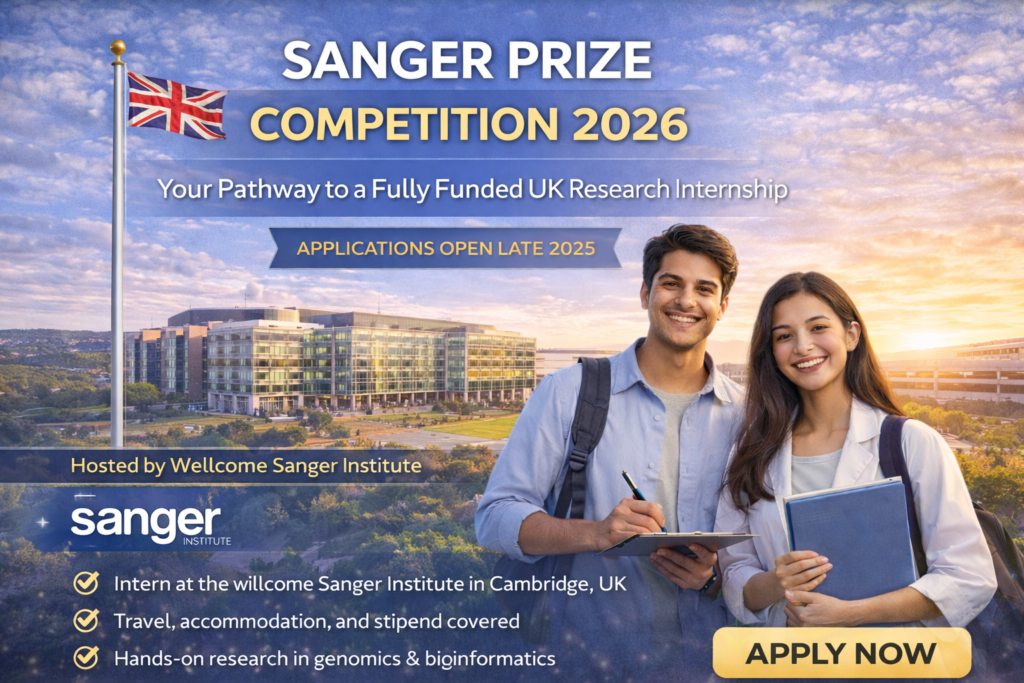
The Wellcome Sanger Institute ensures the winner does not pay a single penny out of pocket:
- International Airfare: Your round-trip flights from your home country to London/Cambridge are fully paid.
- Accommodation: You will stay on or near the prestigious Wellcome Genome Campus in Hinxton.
- Living Expenses: A generous stipend is provided to cover all meals and daily transportation.
- Visa Costs: The institute provides full support for your UK Standard Visitor or Tier 5 visa application, covering the fees.
2. High-Level Mentorship
You don’t just “visit” the lab; you become part of it. The winner is invited to work with a research group of their choice, hosted by a member of the Sanger Faculty. You will be paired with a dedicated mentor who will guide you through advanced genomic techniques and data analysis.
3. Career Transformation
Having “Sanger Prize Winner” on your CV is a massive differentiator. It serves as a strong endorsement when applying for PhD programs at universities like Oxford, Cambridge, or Harvard.
The Two-Stage Selection Process
The Sanger Prize is unique because it is a competition, not just a typical application.
Stage 1: The Initial Application (Current Phase)
In the first stage, you submit your basic information, a CV, and an Expression of Interest (EoI). The EoI is a 400–500 word piece where you describe your interest in genomics and why you want to come to the Sanger Institute.
- Deadline: January 9, 2026 (5 PM GMT).
Stage 2: The Essay Competition
After the January deadline, the Sanger Prize Trustees review all applications. A small number of candidates are shortlisted for the final round. These candidates are then asked to write a formal, scientific essay on a specific topic related to genomics. The winner is chosen based on the quality, originality, and clarity of this essay.
Detailed Eligibility Criteria
To be eligible for the 2026 cycle, you must meet the following criteria:
- National Identity: You must be from a low- or middle-income country as defined by the World Bank (this includes India, Pakistan, Nigeria, Bangladesh, and many others).
- Current Student Status: You must be enrolled in an undergraduate degree at the time of application. This degree must have a “genomics element” (e.g., Biology, Bioinformatics, Medicine, Veterinary Science).
- Age: You must be at least 18 years old.
- Limited Experience: You must not have had any previous international research experience longer than one month in a high-income country.
- English Proficiency: No IELTS or TOEFL is required, but you must demonstrate a high command of English through your writing in the application and essay.
Required Documentation: How to Stand Out
Because the first stage only asks for a CV and an Expression of Interest, these two documents carry immense weight.
| Document | Strategy for Success |
| Curriculum Vitae (CV) | Keep it to 2 pages max. Highlight any genomics-related courses, online certifications (like Coursera/edX), and local lab experience. |
| Expression of Interest | Aim for 450 words. Explain a specific problem in genomics that interests you (e.g., spatial transcriptomics or pathogen sequencing). |
| Academic Referees | You need two lecturers who can speak to your academic curiosity and potential to work in an international setting. |
Inside the Wellcome Genome Campus
If you win, you will be traveling to Hinxton, just outside of Cambridge. The campus is a “science city” shared by the Sanger Institute and the European Bioinformatics Institute (EMBL-EBI).
- The Environment: It is a high-tech, collaborative space with thousands of scientists.
- Networking: You will attend “Genome Science” seminars and coffee mornings where you can chat with the scientists who are literally rewriting the textbooks on human health.
- The Lab Experience: Depending on your interest, you could be doing “wet-lab” work (extracting DNA) or “dry-lab” work (coding in R or Python to analyze massive datasets).
Step-by-Step Application Roadmap
- Check Your Country’s Status: Ensure your country is on the LMIC list provided by the Wellcome Sanger Institute.
- Select Your References: Approach two professors now. They will need to submit their letters by January 16, 2026, just one week after the main deadline.
- Draft Your EoI: Don’t just copy-paste your CV. The Expression of Interest should tell a story about why genomics matters to you.
- Submit Online: Use the official Sanger Institute portal. Do not wait until the last day (January 9), as technical glitches could disqualify you.
Pro-Tips for Winning the Essay Round
If you make it to Stage 2, keep these three tips in mind:
- Evidence-Based Writing: Use citations from recent journals (Nature, Science, Cell).
- Focus on Impact: Discuss how genomics can solve a health problem specific to your region or the world.
- Originality Over Knowledge: The judges aren’t just looking for someone who knows facts; they are looking for a student who can think critically and propose new ideas.
Conclusion
The Sanger Prize Competition 2026 is more than a scholarship; it is a bridge over the “digital divide” in science. It is an invitation for the brightest minds in the developing world to take their place at the leading edge of genomics research.
The clock is ticking! With the first-stage deadline on January 9, 2026, now is the time to start your application and prove that your ideas deserve a global stage.