
The NIMS Internship Program 2026 is now open, offering a rare, fully funded 90-day research experience in the heart of Japan.
Hosted by the National Institute for Materials Science (NIMS), this program is designed for undergraduate and graduate students who want to move beyond the classroom and into state-of-the-art laboratories. In this guide, we break down the eligibility, the “hidden” application process, and the life of a researcher in Tsukuba.
What is the NIMS Internship Program?
NIMS is one of the world’s most cited research institutions in the field of materials science. The internship program is an “academic bridge” that connects international students with leading Japanese scientists.
Unlike traditional internships where you might follow a fixed curriculum, a NIMS internship is project-based. You will join an active research group and contribute to real-world experiments. The goal is simple: to provide practical technical experience that could lead to a future Master’s, PhD, or even a career within the NIMS Joint Graduate School Program.
Why Choose NIMS for Your 2026 Internship?
1. 100% Financial Coverage
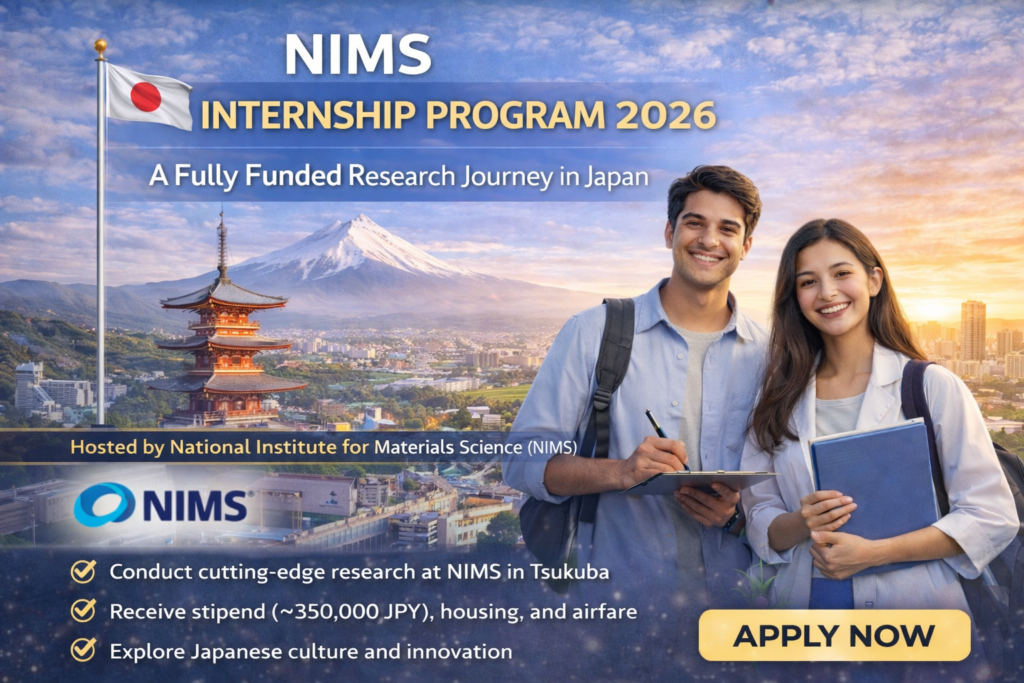
NIMS ensures that financial barriers do not stop top talent. For the 2026 cycle, the benefits include:
- Daily Allowance: You receive ¥2,560 per day (approximately $17–$20 USD) to cover your meals and daily expenses.
- Travel Support: For selected undergraduate students, NIMS provides round-trip international airfare.
- Free Accommodation: You will stay in NIMS-provided housing (such as Ninomiya House or Takezono House) for the entire 90 days. While utilities are usually excluded, the rent itself is fully covered.
- No IELTS/TOEFL Needed: While you must be proficient in English or Japanese, official test scores are not a mandatory requirement for application.
2. World-Class Research Facilities
From electron microscopes to high-magnetic-field facilities, NIMS houses equipment that most universities don’t have. You will learn to use cutting-edge instruments under the guidance of experts who are pioneers in their fields.
3. Networking and Career Growth
An internship at NIMS is a massive boost for students planning to apply for the MEXT Scholarship or other prestigious PhD programs. You’ll leave Japan with a certificate of completion and, more importantly, a professional relationship with a top-tier scientist.
Key Research Areas at NIMS
NIMS is divided into several specialized centers. When searching for a host, consider which area aligns with your background:
- Magnetic and Spintronic Materials: Working on the next generation of hard drives and sensors.
- Energy and Environmental Materials: Developing more efficient solar cells, batteries, and hydrogen storage.
- Biomaterials: Designing materials for bone tissue engineering and drug delivery systems.
- Nanoscale Materials: Researching carbon nanotubes, graphene, and 2D materials.
- Ceramics and Metals: Exploring high-temperature superconductors and aerospace-grade alloys.
Detailed Eligibility Criteria
To be one of the 100 selected interns, you must meet these basic requirements:
- Student Status: You must be a currently enrolled Undergraduate (at least 2nd year), Master’s, or PhD student. You must remain a student for the entire duration of the internship.
- Academic Major: Your field of study must be relevant to materials science, including Chemistry, Physics, Mechanical Engineering, or Biotechnology.
- Duration: You must be able to commit to a consecutive period of up to 90 days.
The “Invisible” Application Process: A Step-by-Step Guide
The NIMS application process is unique because you cannot apply to the office directly. You must find a “Host Researcher” first.
Step 1: Use the SAMURAI Directory
Go to the SAMURAI (NIMS Researcher Directory). Use keywords like “Solid State Physics” or “Polymers” to find researchers whose work matches your interests.
Step 2: Contact the Researcher (The “Cold Email”)
Once you find a potential host, send them an email. This is the most critical part.
- Subject Line: “Inquiry regarding NIMS Internship Program 2026 – [Your Name]”
- Attachment: Include your CV, Transcripts, and the NIMS Internship Application Form.
- Content: Briefly explain why their research interests you and what technical skills you can offer their lab.
Step 3: Getting the “Green Light”
If the researcher is interested, they may schedule an online interview. If they agree to host you, they will submit your application to the NIMS Academic Collaboration Office on your behalf.
Step 4: Final Selection
NIMS reviews the applications submitted by researchers. If you are officially selected, you will receive an acceptance letter and guidance on visa procedures.
Life in Tsukuba Science City
Tsukuba is often called the “Silicon Valley of Japan.” It is a quiet, organized city located about 45 minutes from Tokyo by train (Tsukuba Express).
- Transportation: The city is designed for cycling. NIMS often provides information on how to rent or buy a cheap bicycle for your commute.
- Cost of Living: While your daily allowance of ¥2,560 is helpful, Japan can be expensive. Many interns save money by cooking at their dormitory’s shared kitchen or eating at university cafeterias.
- Community: You will be living and working alongside other international students, making it easy to form a “research family” and explore Japan on the weekends.
Required Documentation Checklist
Ensure all your documents are in English and clear to read:
Pro-Tips for Success
- Don’t “Blast” Emails: Do not email multiple researchers at NIMS simultaneously. Japanese academic culture values sincerity. Pick your top choice, and if they decline, then move to the next one.
- Highlight “Lab Experience”: NIMS is a technical institute. In your CV, emphasize any hands-on experience you have with lab equipment or experimental procedures.
- Check the Deadline: The final deadline for researchers to submit your application is January 30, 2026. You should ideally start contacting researchers by December 2025 to give them enough time to review your profile.
- Mention Future Plans: If you are interested in coming back to Japan for a PhD, mention it! Researchers are more likely to host someone who sees a future with their institution.
Conclusion
The NIMS Internship Program 2026 is one of the most prestigious research gateways in Asia. By providing a fully funded platform at a top-tier national institute, Japan is inviting you to be a part of the next big breakthrough in materials science.
Start your search today! Head over to the SAMURAI directory, find your future mentor, and take the first step toward a summer of discovery in Tsukuba.